 Free Returns
 Free Shipping On All Orders $49.99+
 100% GoGreen Guarantee
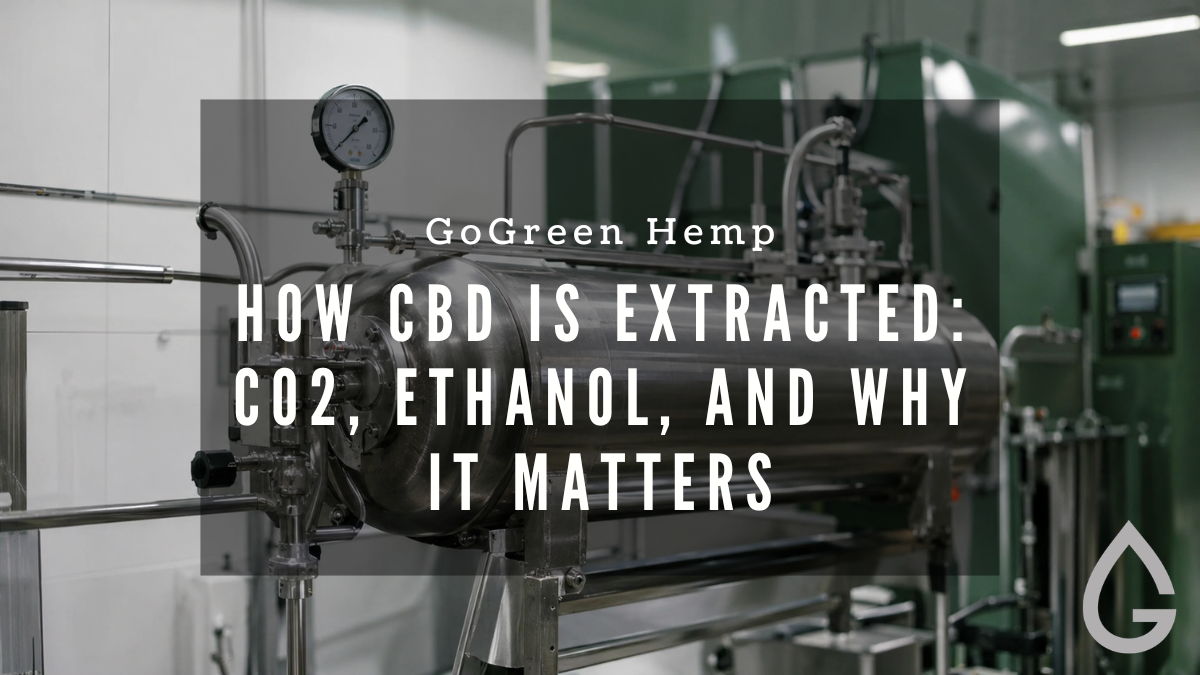
Quick takeaway: How CBD oil is made comes down mostly to extraction. The extraction method affects purity, consistency, and what other compounds end up in your CBD. Supercritical CO2 extraction is the current industry standard for quality because it uses no toxic solvents and gives extractors precise control over the process.
Ethanol extraction is also food-safe and effective, especially at larger scale, but requires careful post-processing to remove plant chlorophyll and waxes. Cheaper hydrocarbon solvents (butane, propane, hexane) can leave trace residues behind if not fully purged. GoGreen Hemp uses a two-step process — CO2 extraction followed by chromatography — specifically to control what ends up in the final product.
Every CBD product starts as a raw plant. Getting the cannabinoids out of that plant and into a bottle, gummy, or softgel requires a solvent of some kind — something that can dissolve the cannabinoids and terpenes out of the plant material so they can be separated from everything else. Which solvent a manufacturer uses, and how carefully they remove it afterward, has more to do with your product's purity than almost any other single factor.
How CBD Oil Is Made, Step by Step
- Grow and harvest hemp. Hemp is grown for its flowers, where cannabinoids are concentrated, and must test under 0.3% THC.
- Dry and grind the plant material so the solvent can reach the cannabinoids.
- Extract. A solvent such as supercritical CO2 or ethanol dissolves the cannabinoids and terpenes out of the plant.
- Refine. Steps like winterization, distillation or chromatography remove waxes, chlorophyll and, for broad-spectrum products, THC.
- Blend with a carrier oil. The concentrated extract is mixed into an oil such as MCT oil to make a measurable tincture.
- Test. An independent lab checks cannabinoid content, THC and residual solvents for each batch.
- Bottle and label with the milligrams per bottle, serving size and a link to the lab report.
The extraction step has the biggest effect on purity, so the rest of this guide looks at the main methods.
What Is CO2 Extraction?
CO2 extraction uses carbon dioxide pressurized and cooled into a "supercritical" state — a point where it behaves partly like a gas and partly like a liquid. In this state, CO2 becomes an effective solvent that can be passed through plant material to dissolve out cannabinoids and terpenes.

Once the pressure is released, the CO2 simply reverts to a gas and evaporates off, leaving behind a clean extract. Because CO2 is a naturally occurring compound (it's what you exhale), there's no toxic solvent residue to worry about, which is a major reason it's considered the gold standard in the industry.
CO2 extraction also gives operators precise control over temperature and pressure, which means they can selectively target specific compounds — a process called fractionation. This is the foundation that more advanced purification steps, like chromatography, build on.
The tradeoff: CO2 extraction requires expensive, specialized equipment and trained operators, and it's slower than solvent-based methods. This is part of why CO2-extracted products often cost more than budget alternatives — the extraction process itself is a bigger investment.
What Is Ethanol Extraction?
Ethanol extraction uses food-grade alcohol as the solvent. Hemp plant material is soaked in or run through ethanol, which readily dissolves cannabinoids, terpenes, and — less usefully — chlorophyll and plant waxes. The ethanol is then evaporated off, leaving the extract behind.

Ethanol is efficient at scale and, like CO2, is food-safe. But because it pulls chlorophyll along with the cannabinoids, ethanol-extracted products often need an additional step called winterization — freezing the extract so waxes and fats solidify and can be filtered out — followed by further filtration to clean up color and flavor. Skip or rush that step, and the result is a darker, more bitter, less refined extract.
What About Hydrocarbon Solvents (Butane, Propane, Hexane)?
These solvents are cheaper and faster than CO2 or ethanol, which is why they show up in some budget and bulk products. The concern is residual solvent: if the extract isn't fully purged of the hydrocarbon after extraction, trace amounts can remain in the final product.
This is exactly why residual solvent testing is one of the most important panels on a Certificate of Analysis (COA). A reputable brand using any extraction method — including hydrocarbons — should be able to show you a lab result confirming solvents were not detected in the finished product.
Fractionation and Chromatography: Going a Step Further
After initial extraction, some manufacturers add a purification step called chromatography, which separates the crude extract into individual cannabinoid fractions. This lets a manufacturer isolate specific cannabinoids, remove essentially all detectable THC, and then recombine chosen fractions to build an extract with a defined cannabinoid profile — commonly what's labeled as "broad spectrum."
This is the process GoGreen Hemp uses: a two-step approach combining CO2 extraction with chromatography, specifically to strip out THC while retaining the other cannabinoids and terpenes naturally present in the plant. You can see the batch-specific results of this process on our lab results page, and read more about our full process on our Why GoGreen Hemp page.
What to Look For on a Label or COA
Extraction Method |
How It Works |
What to Check For |
CO2 (supercritical) |
Pressurized CO2 dissolves cannabinoids, then evaporates off |
Precision, no solvent residue concern, often paired with fractionation |
Ethanol |
Food-grade alcohol dissolves cannabinoids and plant matter |
Confirm winterization/filtration was done — check for clean color and taste |
Hydrocarbon (butane, propane, hexane) |
Cheap, fast solvent extraction |
Residual solvent panel on COA — should read "not detected" |

Whatever method a brand uses, the COA is the real answer key. Look for a residual solvents panel, a full cannabinoid profile confirming potency matches the label, and results tied to the specific batch you're holding — not a generic sample result posted once and never updated.
Does Extraction Method Affect the Final Product?
Extraction method mainly determines purity, consistency, and which compounds carry through into the finished extract — it's a different question from full spectrum vs. broad spectrum vs. isolate, which is about which cannabinoids are intentionally kept or removed after extraction. A well-executed CO2 process gives a manufacturer more control over that downstream decision, which is part of why it's often paired with more precisely formulated products.
Frequently Asked Questions
How is CBD oil made?
Hemp is harvested, dried and ground, then a solvent such as supercritical CO2 or ethanol extracts the cannabinoids. The extract is refined, blended into a carrier oil like MCT oil, tested by an independent lab and bottled.
Is CO2 extraction better than ethanol extraction?
Both are considered safe, food-grade methods. CO2 is generally viewed as the more precise and consistent option and produces no solvent residue by nature of the process, while ethanol is efficient at scale but requires more post-processing to remove plant chlorophyll and waxes.
Is CBD extracted with butane or hexane safe?
It can be, if the manufacturer fully purges the solvent and verifies this with third-party residual solvent testing. Without that testing, there's no way to confirm the extract is free of trace solvent.
Why is CO2-extracted CBD often more expensive?
The equipment and expertise required for supercritical CO2 extraction cost significantly more than simpler solvent-based methods, and that cost is typically reflected in the finished product's price.
What does "winterization" mean?
Winterization is a purification step, most often used after ethanol extraction, where the crude extract is frozen so that fats and waxes solidify and can be filtered out, leaving a cleaner extract behind.
What extraction process does GoGreen Hemp use?
GoGreen Hemp uses a two-step process: supercritical CO2 extraction followed by chromatography, which removes THC while preserving other cannabinoids and terpenes.
About the Author

Romas Marcin — Founder, GoGreen Hemp
Romas founded GoGreen Hemp in 2016 and has spent nearly a decade studying cannabinoids, the endocannabinoid system, and the hemp industry, including the CO2 extraction and chromatography process behind every GoGreen Hemp product.
†FOOD AND DRUG ADMINISTRATION (FDA) DISCLOSURE: These statements have not been evaluated by the Food and Drug Administration. This product is not intended to diagnose, treat, cure, or prevent any disease. Hemp Derived CBD with <0.3% THC.


Leave a comment
This site is protected by hCaptcha and the hCaptcha Privacy Policy and Terms of Service apply.