%20(1).png)
.png)
%20(1).png)
%20(1)%20(1).png)

How Long Does CBD Take to Work? A Practical Guide to CBD Onset Time

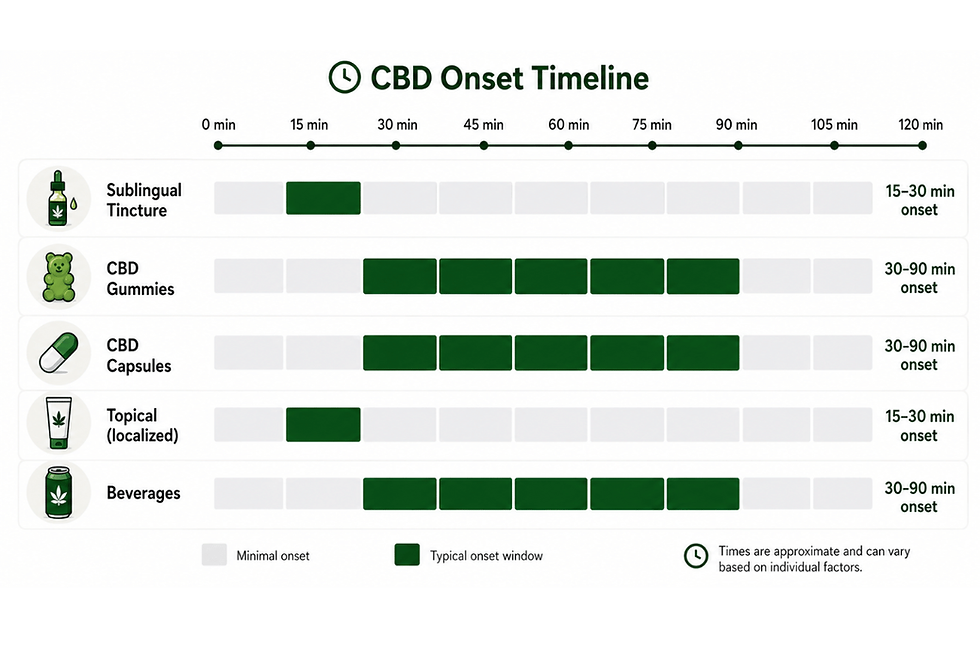
Quick takeaway: How long CBD takes to work depends mostly on how you take it. Sublingual tinctures typically absorb fastest (15-30 minutes for noticeable onset). Gummies and capsules take longer because they go through your digestive system (30-90 minutes). Topicals work locally and typically show effects in 15-30 minutes at the application site. Personal factors — body weight, metabolism, food intake, individual variation — also play meaningful roles. Some people notice CBD within minutes; others take weeks of consistent use before noticing anything; some don't notice meaningful effects at all. This guide walks through the typical absorption timeframes and what affects them.
If you've started using CBD or are thinking about starting, "how long does it take to work" is probably one of your top questions. The honest answer is more nuanced than most CBD content suggests — different products absorb on different timelines, and individual variation is significant.
This guide is about absorption and bioavailability (how and when CBD enters your system), not about specific health effects. What CBD does for any particular person is highly individual, but the pharmacokinetics of absorption are well-established.
CBD Onset Time at a Glance
Method | Typical Onset | Peak Absorption | Approximate Duration |
Sublingual tincture (under the tongue) | 15-30 minutes | 1-2 hours | 4-6 hours |
CBD gummies / edibles | 30-90 minutes | 2-4 hours | 6-8 hours |
CBD capsules | 30-90 minutes | 2-4 hours | 6-8 hours |
Topical (cream, salve, balm) | 15-30 minutes (localized) | Variable | Variable |
Beverages / drinks | 30-90 minutes (depends on formulation) | 1-3 hours | 4-6 hours |
These are general ranges. Individual experience varies significantly based on personal factors discussed below.
Why CBD Timing Varies By Method
The big variable in CBD onset isn't the CBD itself — it's how the CBD reaches your bloodstream. Different consumption methods take very different paths through your body.
Sublingual (Tinctures Held Under the Tongue)
When you hold a CBD tincture under your tongue for 30-60 seconds before swallowing, some of the CBD is absorbed directly through the mucous membranes in your mouth. This:
Bypasses some of your digestive system — meaning faster entry into your bloodstream
Avoids some first-pass liver metabolism — which can reduce how much CBD reaches circulation
Tends to have faster onset than oral/edible methods
Typical onset: 15-30 minutes for most people Peak absorption: Around 1-2 hours Duration of presence in system: 4-6 hours
For our CBD tinctures guide, see the recommended hold-under-tongue technique.
Oral / Edibles (Gummies, Capsules, Beverages)
When you swallow CBD in food or drink form, it travels through your digestive system before entering your bloodstream. This:
Adds digestion time — your stomach needs to process the gummy or capsule before absorption begins
Subjects CBD to first-pass liver metabolism — your liver processes some of the CBD before it reaches your bloodstream
Results in slower onset but typically longer duration
Typical onset: 30-90 minutes for most people Peak absorption: Around 2-4 hours Duration of presence in system: 6-8 hours
Food matters for edibles. Taking CBD gummies on an empty stomach vs. with a meal affects absorption. Fatty foods can actually improve CBD absorption (CBD is fat-soluble), but they also slow the onset because digestion takes longer.
Topical (Creams, Salves, Balms, Sticks)
When you apply CBD to your skin, it works very differently than ingested CBD. Topical CBD:
Doesn't typically enter your bloodstream in meaningful amounts
Works locally at the application site
Doesn't go through digestive or hepatic metabolism
Has effects limited to the area of application
Typical onset: 15-30 minutes at the application site Duration: Varies significantly by product formulation
For more on topicals, see our CBD Topicals for Everyday Skin guide.
Beverages / CBD Drinks
CBD in beverage form is a special case. Onset depends heavily on how the CBD is formulated:
Water-soluble or nanoemulsion CBD in beverages may absorb faster than oil-based forms
Standard CBD oil in a beverage absorbs at roughly oral/edible timelines
CBD added to coffee has its own variables (caffeine's quick absorption may make subjective experience different)
Beverage CBD is less standardized than tinctures or gummies, so timing varies more across products.
Personal Factors That Affect CBD Timing
Beyond the consumption method, several individual factors affect how quickly CBD becomes bioavailable in your system:

Body Weight and Composition
Larger bodies may need higher doses to reach the same circulating CBD levels. Body fat percentage matters too — CBD is fat-soluble, so it can be stored in fatty tissues and released slowly over time.
Metabolism Speed
People with faster metabolisms may process CBD more quickly — both meaning faster onset and shorter duration. Slower metabolisms may have delayed onset but extended duration.
What You've Eaten
For oral/edible CBD:
Empty stomach: Faster onset, but potentially lower total absorption
With a meal: Slower onset, but potentially higher total absorption (especially with fatty foods)
With high-fat meal: Can significantly increase CBD bioavailability — some research shows fatty meals can quadruple CBD absorption
For sublingual CBD, food matters less because much of the absorption happens before swallowing.
Individual Variation
This is the factor most people underestimate. Studies on CBD bioavailability show wide variation between individuals — sometimes 3-4x differences in how much CBD reaches the bloodstream from the same dose. This is one reason CBD experience varies so much person-to-person.
CBD Dose and Concentration
Higher doses may produce more noticeable absorption (and faster perceived onset for some people). Very low doses may take longer to produce noticeable effects, or may not produce noticeable effects at all for some individuals.
Product Quality and Formulation
Not all CBD products are equal. Factors affecting absorption include:
Product freshness and storage (CBD can degrade over time)
Carrier oil quality (MCT oil and coconut oil are commonly used because they support CBD absorption)
Cannabinoid profile (full-spectrum, broad-spectrum, and isolate may absorb differently — see our Different Types of CBD guide)
Manufacturing quality (poor manufacturing can affect actual CBD content)
For more on verifying product quality, see How to Read CBD Labels and How to Find a Trustworthy CBD Brand.
What "Working" Actually Means
Here's something most CBD content glosses over: "CBD working" isn't always a single event you'd notice.
People experience CBD differently:
Some people notice subtle changes within the typical onset windows
Some people report nothing dramatic but say they feel "different" overall after consistent use
Some people notice nothing for days or weeks of regular use, then report gradual changes
Some people never notice meaningful changes from CBD
This individual variation is real and well-documented. CBD isn't like caffeine or alcohol where most people have similar, predictable subjective experiences. The variation in response is one of the reasons CBD research is challenging to interpret.
Honest framing: if you take CBD expecting a dramatic, fast onset like with stimulants or sedatives, you may be disappointed even if the CBD is working. Subtle, gradual, or even unnoticed responses are common.

Onset vs. Duration: Two Different Questions
Onset (this post) is about when CBD becomes bioavailable. Duration is a different question — how long CBD stays in your system. The two are related but distinct.
For most consumption methods:
Faster onset often correlates with shorter total duration
Slower onset often correlates with longer total duration
This is why some people prefer tinctures for quick onset and gummies for sustained presence — the two formats trade off against each other.
For a deeper look at duration specifically (and how long CBD stays detectable in your system), see our How Long Does CBD Last guide.
How to Find Your Optimal Approach
Given how much individual variation affects CBD timing, finding what works for you is largely about systematic experimentation:
1. Start With One Method at a Time
Don't simultaneously try multiple CBD formats. Pick one — typically a tincture is the most flexible starting point — and use it consistently for at least 1-2 weeks before judging.
2. Note Onset Time for You Specifically
Track when you actually notice anything. Some people experience CBD onset earlier than the typical ranges; others later. Your personal pattern matters more than the averages.
3. Adjust One Variable at a Time
If you're not getting the timing you want:
Try with food vs. without food
Try a higher or lower dose
Try holding tincture under tongue longer
Try a different time of day
4. Consider Whether You're Looking for Acute or Cumulative Effects
Some people use CBD for moment-to-moment situations; others use it as a daily wellness routine where cumulative use over time matters more than per-dose timing.
5. Be Patient With Your Assessment
Subtle effects can be hard to notice. Some people benefit from journaling or tracking how they feel over time, which can reveal patterns that day-to-day observation misses.
When CBD Doesn't Seem to Work
If you've tried CBD consistently for several weeks and notice nothing, possible reasons include:
Individual variation — some people don't respond meaningfully to CBD
Product quality issues — your product may not contain the CBD it claims to (lab-tested products from reputable brands address this)
Dose too low — you may need a higher dose; consult product guidance
Wrong method for your goal — if you want fast onset, edibles may not be ideal; if you want sustained presence, tinctures may not be ideal
Timing or routine issues — taking CBD at a different time may help
Subtle effects you're not noticing — keeping a journal sometimes reveals patterns
For starter guidance, see our Beginner's CBD Guide.
Frequently Asked Questions
How long does CBD take to work?
It depends largely on how you take it. Sublingual tinctures typically have the fastest onset (15-30 minutes), followed by topicals (15-30 minutes for localized effects), then oral methods like gummies and capsules (30-90 minutes). Personal factors like metabolism, body weight, and food intake also affect timing significantly.
How long does CBD tincture take to work?
CBD tincture held under the tongue typically begins absorbing within 15-30 minutes. Peak absorption is usually around 1-2 hours. For best results, hold the tincture under your tongue for 30-60 seconds before swallowing to maximize sublingual absorption.
How long do CBD gummies take to kick in?
CBD gummies typically take 30-90 minutes to begin showing effects, with peak absorption around 2-4 hours. Gummies and other edibles take longer than tinctures because they must pass through the digestive system. Taking them with fatty foods can affect both onset time and total absorption.
Why does CBD take longer to work for some people?
Individual variation in CBD absorption can be significant — studies show 3-4x differences between individuals receiving the same dose. Factors include body weight, metabolism speed, body composition, what you've eaten, and individual differences in how the digestive system processes CBD.
Should I take CBD with food?
For oral/edible CBD (gummies, capsules), taking with food — especially fatty food — may significantly increase total CBD absorption, though onset will be slower. For sublingual tinctures held under the tongue, food matters less because much of the absorption happens before swallowing. Experiment to find what works for you.
Can you take too much CBD if it doesn't work fast enough?
It's generally recommended to wait the full onset window (1-2 hours for sublingual, 2-3 hours for edibles) before adding more, since CBD effects can be subtle and adding more before the first dose has fully absorbed can lead to taking more than needed. Start low, go slow, and increase gradually.
How long until I should expect to feel CBD?
Within the typical onset windows for your method (15-30 minutes sublingual, 30-90 minutes oral), if you're going to notice anything from a single dose, you typically will. However, some people only notice CBD effects after days or weeks of consistent use, and some people don't notice dramatic effects even with regular use. Individual variation is significant.
Why don't I feel anything from CBD?
Several possible reasons: individual variation (some people don't respond meaningfully to CBD), dose may be too low, product quality issues (a product without verified lab testing may not contain claimed CBD), timing or method mismatched to your goal, or subtle effects you're not noticing day-to-day. Try verified products from reputable brands with lab testing.
What's the fastest way to feel CBD?
Sublingual tinctures (held under the tongue for 30-60 seconds before swallowing) typically provide the fastest noticeable onset of legal CBD methods, around 15-30 minutes. Note: vaping CBD provides faster onset, but vape products carry their own considerations and aren't part of GoGreen Hemp's product line.
How long does CBD effect typically last?
Duration depends on consumption method. Sublingual tinctures typically have effects (or detectable CBD) for 4-6 hours. Oral methods like gummies and capsules typically last 6-8 hours. Topicals are variable by product. For more on duration specifically, see our How Long Does CBD Last guide.
Final Thoughts
The most honest answer to "how long does CBD take to work?" is: it depends, and your experience may not match anyone else's.
Sublingual tinctures absorb fastest (15-30 minutes). Edibles take longer (30-90 minutes) but typically last longer. Topicals work locally. Personal factors — metabolism, body weight, food, individual variation — all play significant roles.
Some people notice CBD quickly; some notice gradually; some don't notice it dramatically at all. None of these experiences is wrong. CBD response varies widely between individuals, and finding what works for you is largely about consistent experimentation with quality products.
If you're starting out, a sublingual tincture is typically the most flexible entry point because it gives you fine control over dose and the fastest onset feedback. From there, you can explore other formats based on what fits your routine.
About the Author

Romas Marcin — Founder, GoGreen Hemp
Romas founded GoGreen Hemp in 2016 and has spent nearly a decade studying cannabinoids, the endocannabinoid system, and the hemp industry. He leads product development and quality standards across all GoGreen Hemp products, with particular interest in helping customers understand how to actually use CBD effectively based on accurate pharmacokinetics rather than overstated marketing.
Read full bio → https://www.gogreenhemp.com/meet-the-team
Connect on LinkedIn → https://www.linkedin.com/in/romas-marcin/
These statements have not been evaluated by the Food and Drug Administration. Hemp-derived products are not intended to diagnose, treat, cure, or prevent any disease or condition. This article provides general educational information about CBD absorption; individual experience varies significantly. This is not medical advice.
Comments