 Free Returns
 Free Shipping On All Orders $49.99+
 100% GoGreen Guarantee

Quick answer: CBG benefits are one of the most searched topics in hemp, but the honest answer is that research is still early. CBG (cannabigerol) is non-intoxicating, interacts with the body's endocannabinoid system and has shown interesting results in lab and animal studies. Human research is limited to a handful of small studies, and CBG is not approved to treat any condition. Below is what's actually known, what's still being studied and how people use CBG today.
You'll find plenty of websites listing ten or fifteen "proven" CBG benefits. Most of them stretch early lab findings into promises the science doesn't support yet. We'd rather tell you exactly where the research stands, so you can decide for yourself whether CBG belongs in your routine.

First, a Quick Refresher: What Is CBG?
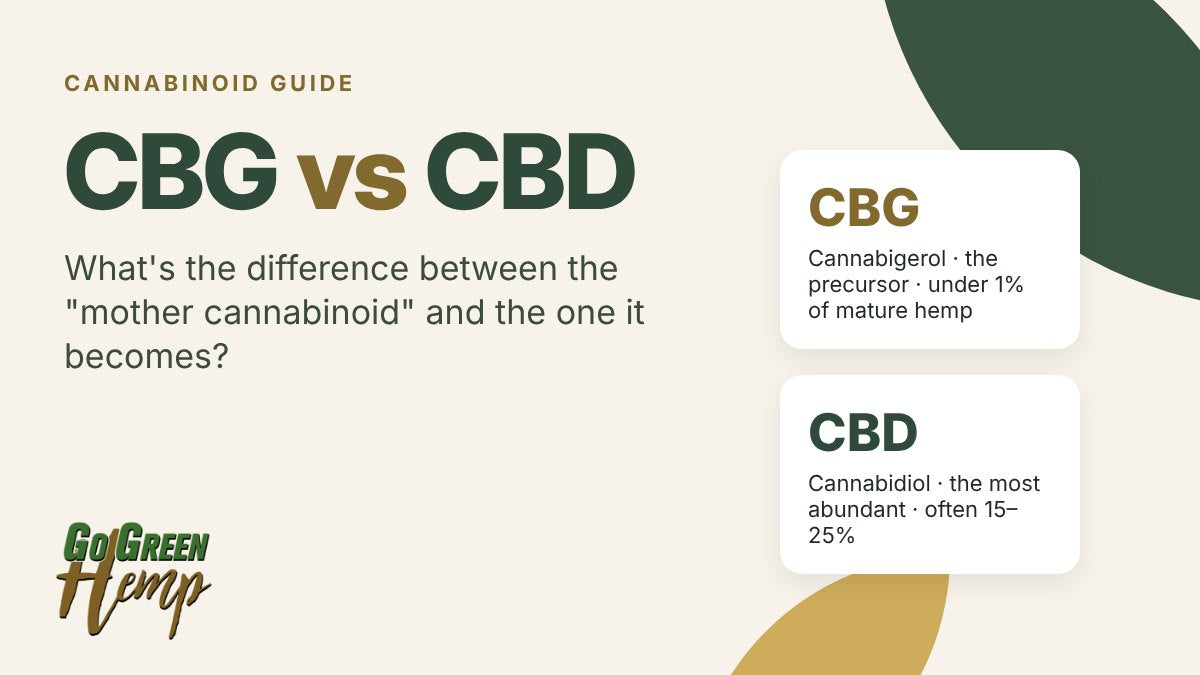
CBG is the "mother cannabinoid." The hemp plant makes CBGA early in its life and converts most of it into the acid forms of CBD, THC and CBC, which is why mature hemp contains less than 1% CBG. It's non-intoxicating and federally legal when derived from hemp with less than 0.3% THC. Learn more in What Is CBG? and CBG vs CBD.
What the Research Shows So Far
Human research: small but growing
The most talked-about human study is a 2024 double-blind, placebo-controlled trial from researchers at Washington State University, published in Scientific Reports. Healthy adults took 20mg of hemp-derived CBG or a placebo on separate days. Participants reported lower feelings of anxiety and stress after CBG than after the placebo, CBG didn't cause intoxication, and it was well tolerated. It was a small, short study in healthy people, so the researchers called for larger trials before drawing conclusions.
Before that, a 2021 survey published in Cannabis and Cannabinoid Research asked people who used CBG-predominant products why they used them. Many reported using CBG for stress, sleep and discomfort. Surveys like this show how people use CBG, but they can't prove that it works.
Lab and animal research: where most of the data lives
Most CBG research has been done in cells or animals. These studies help scientists decide what to test in people, but results in a petri dish or a mouse often don't carry over to humans. Areas researchers have looked at include:
- The endocannabinoid system. Lab studies show CBG binds directly, though weakly, to both CB1 and CB2 receptors and interacts with some other receptor types.
- Inflammation and gut health. Several animal studies have explored CBG in models of gut inflammation.
- Antibacterial activity. Lab studies have found CBG active against certain bacteria, including some drug-resistant strains, in a test tube.
- Appetite. Animal research has looked at whether CBG affects feeding behavior.
- The nervous system. Researchers have studied CBG in animal models of nerve cell damage.
None of these findings mean CBG will do the same thing in people, and none of them make CBG a treatment for anything.
What CBG Is Not
- It's not a stimulant. CBG isn't caffeine. People who use it during the day usually describe feeling steady rather than energized.
- It's not intoxicating. Hemp-derived CBG won't get you high.
- It's not FDA-approved to diagnose, treat, cure or prevent any disease. Be wary of any CBG product that promises specific health results.
How People Use CBG Today
In practice, CBG is mostly found in daytime products blended with CBD. Many people like the idea of a daytime cannabinoid routine: a CBG + CBD product in the morning or early afternoon and a CBD or CBN product in the evening. Common formats include gummies, tinctures and softgels.
If you'd like to try CBG, a few tips:
- Start low. Begin with one serving and see how you feel before taking more.
- Be consistent. Take it at the same time each day so you can judge how it fits your routine.
- Check the label. It should list milligrams of CBG and CBD per serving, not just "hemp extract."
- Check the lab report. A batch-matched COA confirms the CBG content and shows whether THC is present.
- Talk to your doctor if you take prescription medication, are pregnant or nursing, or have a medical condition.
Our CBG + CBD Daytime Gummies

GoGreen Hemp CBG + CBD Daytime Gummies contain 15mg CBG and 15mg CBD per gummy, with 40 gummies per bottle. They're:
- THC-free (0.0% THC)
- Vegan and gluten-free
- Naturally lemon flavored and colored with turmeric, with no artificial dyes
- Infused, not sprayed, so every gummy matches the label
- Third-party lab tested, with results on our lab results page
Many customers take them in the morning and use our CBN + CBD Sleep Gummies in the evening.
Frequently Asked Questions
What are the benefits of CBG?
CBG research is still early. One small 2024 human trial found 20mg of CBG was well tolerated, and participants reported less stress and anxiety than with placebo. Most other research is in cells and animals. CBG is not approved to treat any condition.
Does CBG help you focus?
Many people choose CBG for daytime routines, but there isn't solid research yet showing that CBG improves focus. Individual experiences vary.
How much CBG should I take?
There's no established serving size for CBG. The 2024 study used 20mg. Most CBG products contain 10–25mg per serving. Start with one serving and talk to your doctor if you take medication.
Is CBG better than CBD?
Neither is "better." CBD is far more studied and widely available; CBG is scarcer and newer to the market. Many people use them together. See CBG vs CBD for a side-by-side comparison.
Does CBG have side effects?
CBG appears to be well tolerated in the limited human research available, but there isn't much long-term data. Like CBD, it may cause drowsiness, dry mouth or stomach upset in some people, and it may interact with some medications.
Will CBG make me fail a drug test?
Drug tests screen for THC, not CBG. Choose THC-free products and check the lab report if you're tested. Read more in Does CBD Show Up on a Drug Test?
Final Thoughts
CBG is one of the most interesting cannabinoids in hemp, and the early research is worth watching. But "promising" isn't the same as "proven." If you're curious, try a lab-tested CBG + CBD product with clear milligram amounts, start with one serving and see how it fits your day.
Shop CBG + CBD Daytime Gummies →
Sources: Cuttler C, et al. "Acute effects of cannabigerol on anxiety, stress, and mood: a double-blind, placebo-controlled, crossover, field trial." Scientific Reports, 2024. Russo EB, et al. "Survey of patients employing cannabigerol-predominant cannabis preparations." Cannabis and Cannabinoid Research, 2021.
About the Author

Romas Marcin — Founder, GoGreen Hemp
Romas founded GoGreen Hemp in 2016 and has spent nearly a decade studying cannabinoids, the endocannabinoid system, and the hemp industry. As a former college athlete and lifelong wellness advocate, he leads product development and quality standards across all GoGreen Hemp products.
Read full bio → Connect on LinkedIn →
These statements have not been evaluated by the Food and Drug Administration. Hemp-derived products are not intended to diagnose, treat, cure, or prevent any disease or condition. Always consult a healthcare professional before adding any new supplement to your routine.


Leave a comment
This site is protected by hCaptcha and the hCaptcha Privacy Policy and Terms of Service apply.