 Free Returns
 Free Shipping On All Orders $49.99+
 100% GoGreen Guarantee

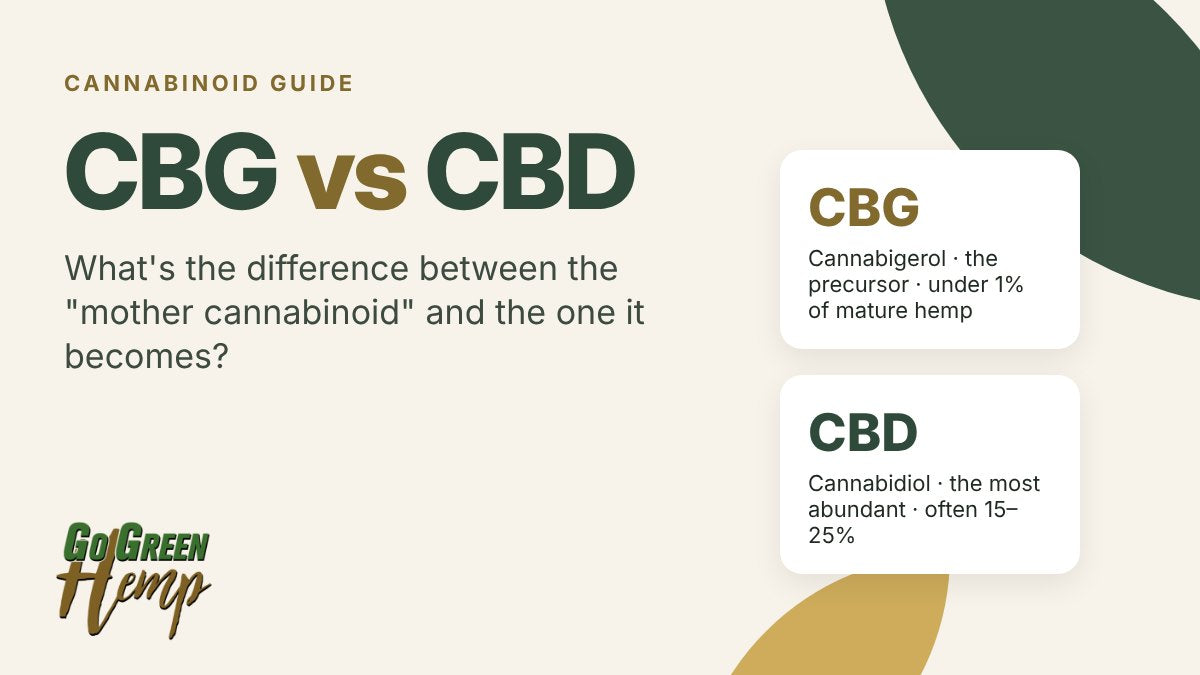
Quick answer: CBG vs CBD comes down to where each one sits in the hemp plant's life. CBG (cannabigerol) is the precursor: the plant turns it into CBD, THC and other cannabinoids as it grows. CBD (cannabidiol) is the end product the plant makes the most of. Both are non-intoxicating when they come from hemp. CBD is far more common and much better studied, while CBG is scarcer, pricier and usually found in daytime products blended with CBD.
If you've seen CBG on a gummy label next to CBD and wondered whether it's just another name for the same thing, it isn't. The two are chemically related, but they come from different stages of the plant's growth, interact with the body in different ways and show up in different kinds of products. Here's a plain-language comparison so you can decide which one, or which blend, fits your routine.

What Is CBG?
CBG, short for cannabigerol, is often called the "mother of all cannabinoids." Early in the plant's life, hemp produces CBGA (the acid form of CBG). Enzymes in the plant then convert most of that CBGA into the acid forms of CBD, THC and CBC. Only a small amount stays behind as CBG.
That's why a mature hemp plant usually contains less than 1% CBG. Growers who want more of it either breed CBG-rich hemp varieties or harvest the plant earlier, before the conversion is finished. For a deeper look, see our full guide: What Is CBG?
What Is CBD?
CBD, short for cannabidiol, is the most abundant cannabinoid in most hemp grown today. Some CBD-rich varieties contain 15–25% CBD by dry weight, so it's easy to extract in large amounts. CBD is non-intoxicating, it's the most researched cannabinoid besides THC, and it's the active ingredient in one FDA-approved prescription medicine for certain rare seizure disorders. (Store-bought CBD products are not approved to treat any condition.)
CBG vs CBD: 6 Key Differences
1. Where they come from in the plant
CBG comes first. CBD is made from it. Every CBD molecule in a hemp plant started life as CBGA.

2. How much of each is in hemp
Hemp typically holds well under 1% CBG at harvest compared with up to 15–25% CBD in CBD varieties. That scarcity is the main reason CBG products cost more per milligram.
3. How they interact with the endocannabinoid system
Both interact with the body's endocannabinoid system (ECS), but differently. CBD has a low affinity for the two main cannabinoid receptors, CB1 and CB2, and is thought to work mostly in indirect ways. Lab research suggests CBG binds directly to both CB1 and CB2, though weakly, and it also interacts with some non-cannabinoid receptors. Researchers are still working out what those differences mean in people.
4. How much research exists
CBD has decades of research behind it, including large human trials. CBG research is much newer. Most studies so far have been done in cells or animals, and human studies are small. A 2024 double-blind, placebo-controlled trial published in Scientific Reports gave healthy adults 20mg of hemp-derived CBG and found it was well tolerated; larger studies are needed before anyone can draw firm conclusions. Read more in CBG Benefits: What the Research Actually Says.
5. When people tend to take them
CBD is used any time of day. CBG has become a favorite for daytime and morning routines, usually paired with CBD. Many people take a CBG + CBD product in the morning and switch to CBD or CBN in the evening.
6. Price
Because the plant makes so little of it, CBG costs more to produce. Expect CBG products to cost more per milligram than CBD products of similar quality.
What They Have in Common
- Neither gets you high. Hemp-derived CBG and CBD are both non-intoxicating.
- Both are federally legal when derived from hemp containing less than 0.3% THC, though state rules vary. Learn more in our CBD oil guide.
- Both need lab testing. The label should state milligrams of each cannabinoid per serving, backed by a batch-matched certificate of analysis (COA).
- Neither is approved by the FDA as a dietary supplement or to treat any condition.
CBG vs CBD: Which Should You Choose?
Choose CBD if you want the most researched option, the widest range of formats (oils, gummies, softgels, topicals) and the lowest cost per milligram.
Choose a CBG + CBD blend if you want a daytime product and are curious about CBG. Because CBG is usually sold alongside CBD, a blend lets you try both, and many people like the idea of the two working together (sometimes called the "entourage effect," which is still being studied).
Choose either with care if you take prescription medication. Cannabinoids can interact with how your liver processes some drugs, so check with your doctor or pharmacist first.
Not sure where to start? Our 60-second CBD quiz will point you to a product that fits your routine.
Our CBG + CBD Daytime Gummies
Our CBG + CBD Daytime Gummies pair 15mg CBG with 15mg CBD in every gummy, 40 gummies per bottle. They're THC-free, vegan, naturally lemon flavored, colored with turmeric instead of artificial dyes, and infused rather than sprayed so each gummy matches the label. Every batch is third-party tested, and you can see the results on our lab results page.
Frequently Asked Questions
Is CBG stronger than CBD?
Not in a simple sense. They're different compounds with different roles. A milligram of CBG isn't "stronger" than a milligram of CBD; it just interacts with the body differently. What matters more is the amount per serving and the quality of the product.
Can you take CBG and CBD together?
Yes. Most CBG products are sold as CBG + CBD blends. If you take medication, ask your doctor or pharmacist before adding either one.
Does CBG get you high?
No. Hemp-derived CBG is non-intoxicating, just like CBD.
Will CBG or CBD show up on a drug test?
Standard drug tests look for THC, not CBG or CBD. Full-spectrum products can contain trace THC, so choose THC-free products and check the COA if you're tested. See our guide: Does CBD Show Up on a Drug Test?
Why is CBG more expensive than CBD?
Mature hemp contains much less CBG than CBD, so producing the same amount takes more plant material or specially bred, early-harvested hemp.
What's the difference between CBG, CBD and CBN?
CBG is the precursor, CBD is the most abundant cannabinoid the plant makes from it, and CBN forms later when THC breaks down with age, heat and light. CBG and CBD are popular in daytime products, while CBN is mostly used in evening products, like our THC-free CBN + CBD tincture. Compare them in CBN vs CBD.
Final Thoughts
CBG and CBD are close relatives, not twins. CBD is the abundant, well-studied mainstay; CBG is the rarer precursor that's earning attention, mostly in daytime blends. Whichever you choose, look for clear milligram amounts, THC-free options if you need them and a public lab report for every batch.
Shop CBG + CBD Daytime Gummies →
About the Author

Romas Marcin — Founder, GoGreen Hemp
Romas founded GoGreen Hemp in 2016 and has spent nearly a decade studying cannabinoids, the endocannabinoid system, and the hemp industry. As a former college athlete and lifelong wellness advocate, he leads product development and quality standards across all GoGreen Hemp products.
Read full bio → Connect on LinkedIn →
These statements have not been evaluated by the Food and Drug Administration. Hemp-derived products are not intended to diagnose, treat, cure, or prevent any disease or condition. Always consult a healthcare professional before adding any new supplement to your routine.

Leave a comment
This site is protected by hCaptcha and the hCaptcha Privacy Policy and Terms of Service apply.